Friday, June 22, 2018

So What?....Now What?

 When you hear the word GMO what comes to your mind? It is something that you are familiar with or is there more to learn? The last blog posts have been exclusively about GMO’s and how they are viewed both negatively and positively. So why does it matter? How does what you know change your actions or food choices? There is so much information still available to study and learn about, so really this is just the tip of the iceberg in learning about GMO’s. 

Even with opposition, it is pretty obvious that GMOs aren’t going to go away any time soon. Whether or not we like it, each of us will be affected one way or another by GMO’s. By 2050 it is expected to have the need to produce 70% more food to feed the world (Naam, 2014). This is going to require that the food being produced is resistant to insects, anddrought, and have an increase in nutrient availability. In richer countries citizens, can be more creative and selective with their food sources. They will have the ability to choose organic foods or non GMO foods but in poor countries there is a need for these foods. In places like India where pesticides cost a whole lot and aren’t as available these GM crops are fulfilling the needs for farmers (Naam, 2014).  Whether you are for or against GMO production, the research that has been done on their benefits show that they are no different from other foods and do not contain harmful substances (Modern Ag, 2017). The scientist working on these foods are feeding the same foods to their families and to themselves, why would they allow something that is harmful on the market? 

But the question about the future of GMO’s is still there. Is there a potential for something harmful to end up in the food chain from lack of conscious attention? Right now, we are right in the middle of elections for individuals who will hopefully listen to the voice of the people and run the country accordingly. As the number one food source to the world we each have a say in who is elected and it is so important that we play a role in selecting people who will put laws in place the require regulations of foods before they hit the market both here and in foreign countries. We each need to take a stand in making sure that genetically modified foods go in the right direction and continue to be a good part of food technology instead of a regret. It is important that we are informed and that we do our research from valid sources. It is important that we look at both sides of the argument from several different angles to understand what is really at stake. We need to be proactive on every side of the food network. 

Works Cited

Modern Ag. (2017, February 1). The Science Inside a GMO Seed. Retrieved June 22, 2018, from Modern Ag: https://modernag.org/innovation/the-science-inside-gmo-seeds/?gclid=CjwKCAjw9qfZBRA5EiwAiq0AbVb37YjSD4QmyuRQpx6_5QxHzUjH1gu-g9-bnolu_UqDhyJWvr1schoCIOkQAvD_BwE&gclsrc=aw.ds
Naam, R. (2014, January 22). Why GMO's matter- especially for the dveloping world. Retrieved June 22, 2018, from Grist: https://grist.org/food/why-gmos-do-matter-and-even-more-to-the-developing-world/

Sunday, June 17, 2018

GMO Labeling Law

Can you think of a law that was recently passed that affected your life personally? For years the government has passed laws that contributed to either life of leisure for some or heartache for others. This has especially been true for GMO's. They have become a hot topic on Capital hill over the last little while and have divided many groups of people on what should be done in regard to labeling, documentation, and even if genetically modifying food should be legal. There is one particular law recently have has had a major impact on GMO production. 

This law came about when GMOs became more abundant on the market and several companies and groups began to question the safety of these foods. Pressure began for the government to require companies to label any foods that contain GMO’s. This process took some time while scientist studied the safety of these foods and eventually found no difference between the GMO foods and non GMO foods (Charles, 2016). This didn’t seem convincing enough. The pressure continued to come, eventually lead to the passing of the GMO labeling law (Lynas, 2016).

Back in July of 2016 President Obama passed a law that required that genetically modified organisms be labeled (USDA, 2018). This required that any foods that contain GMO ingredients would be labeled or have a QR code that would tell consumers if it contains GMOs. Although imported foods don’t have the same requirement. This would require additional information from foreign producers so that the foods can be labeled properly (Poinski, 2017).

I would imagine that questions about GMOs will not end any time soon and the government will continue to be involved. This just requires that citizens of the United States continue to be involved in selecting good leaders for our country that have our best interest in mind. 

Worked Cited:
Charles, D. (2016, July 16). Congress just passed a GMO lableing bill. No ones super happy about it.Retrieved June 17, 2018, from The Salt:Whats on your plate: https://www.npr.org/sections/thesalt/2016/07/14/486060866/congress-just-passed-a-gmo-labeling-bill-nobodys-super-happy-about-it
Lynas, M. (2016, May 23). The GMO debate is over.Retrieved June 17, 2018, from Alliance for Science : https://allianceforscience.cornell.edu/blog/2016/05/gmo-safety-debate-is-over/
Poinski, M. (2017, June 7). USDA on GMO Labeling Law: Still on track but alittle behind.Retrieved June 17, 2018, from Food Dive: https://www.fooddive.com/news/usda-on-gmo-labeling-law-still-on-track-but-a-little-behind/444383/
USDA. (2018, March 6). Labeling of food derived from Genetically Engineered Plants.Retrieved from US Department of Health and Human Services: https://www.fda.gov/Food/IngredientsPackagingLabeling/GEPlants/ucm346858.htm


Friday, June 8, 2018

Word on the Street

Imagine you are sitting in a tee-pee with a story teller of your tribe as he tells you stories that have been passed down from generation to generation. He tells you about moving from place to place, the art of finding and using buffalo as a resource, and many more stories. His stories can be described as folklore. Folklore is described as something that is handed down from generation to generation, usually not written down. Folklore can be looked at as being old and from the past, but in reality our way of life contributes to folklore and how the future generations see the world. I came across this short clip from the Jimmy Kimmel show that is an example how folklore can be passed from individual to individual. While Jimmy Kimmel's show wouldn't be considered folklore itself what he is asking these individuals on the street is a good example. This particular clip, his crew is asking the public what GMO's are and why they avoid them.  His findings are comical and interesting. 

After watching this short video I found myself answering the questions that Jimmy Kimmel asks. I found that a lot of my understanding has come from what I have heard in my own family and peer group. As I have studied the topic I have found that some of the information that I heard from these individuals are true and some of it is more personal opinion from whomever I was talking too. I came to realize how important it is that we check our sources and not believe everything we hear about a topic because it could possibly not be true. The information about GMO's is a great example of skewed ideas and often incorrect information passed from one individual to another. A recent study has shown that 43% of Americans could correctly identify what genetically modified foods are (Branson, 2013). I would imagine that a lot of the perceptions of these individuals come from what they hear from friends and acquaintances.  GMO's have become information passed from around and in a way, turned into its own folklore, as the idea goes from person to person. Whether that information is true or false, it will continue on its way through history and continue to be told from generation to generation. 

Worked Cited:

Branson, K. (2013, November 1). Most Americans Pay Little Attention to Genetically Modfied Foods, Survey Says. Retrieved June 8, 2018, from Rutgers Today: https://news.rutgers.edu/research-news/most-americans-pay-little-attention-genetically-modified-foods-survey-says/20131101#.Wxq_-C_MzMI


Kimmel, J. (2014, October 9). What a GMO? Jimmy Kimmel Live. Los Angles , CA, USA.

Saturday, June 2, 2018

From a Farmers Perspective

Imagine farming back in the early 1900's. A lot of farmers used horse drawn equipment and a lucky few had machinery to help with their work. Towards the middle of the century there was an increase in machinery use, but farmers still relied on farm hands to get a lot of their work done. The main focus of these farmers at the beginning was to feed their families; however, as time went on and demands changed, a select few continued in agriculture and farming to produce food for a growing world. They had a big responsibility of feeding the world. Norman Borlaug said "Civilization as it is known today could not have evolved nor can it survive without an adequate food supply."  By the year of 2050, the world’s population is expected to raise to 9.7 billion people (York, 2015). With that increase in population there will have to be an increase in food supply but since the 1970's there has been a sharp decline in farms in the United States resulting in currently only 2.1 million operating farms (USDA, 2018). So the man power on farms in the United States has changed from physical man power to mechanical and technological. The farmers that run the farms today have to be more sustainable then before. Kevin Rogers, an Arizona farmer said" Sustainability is a world not often associated with GMOs in popular press, but farmers who grow GMO crops see them as a tool for sustainable farming (Manager,2018)." GMO crops have become the solution for many famers that find they can produce double the crop on half the land. Using GMO crops that are resistant to insects and droughts have allowed them to produce crops using less pesticides and other harmful substances. This has equally helped the soils that these crops are planted in. Katie Pratt, an Illinois farmer, stated that they have greatly reduced the amount of insecticide that needs to be sprayed, and they only need to treat the weeds at one point, not several times over a growing season. Her soil has now improved (Manager, 2018). She isn't the only one that has seen these results. There are many examples of farmers that have used GMO crops and seen an increase sustainability and decrease in production cost. With this increase in GMO use and decrease in production needs, the man power behind farming has significantly decreased. Early on in farming there was a large need required to plow the field, keep the insects at bay, and control the weeds, but what is required now is the knowledge to propagate, in keeping the crops alive, and keeping the soil healthy to receive these crops. Man power in farming is in a way moving away from the fields and towards the lab where a lot of work is done to produce GMO seeds with a larger range of propagation options. Farmers are changing in the way they do their job. They work hard to produce an adequate food supply for the world in the most productive way they can. That's real man power.  

References 
Johnson, M. (2014, April 25). GMOs- From a Farmers Perspective. Retrieved June 2, 2018, from U.S.News Health: https://health.usnews.com/health-news/blogs/eat-run/2014/04/25/gmos-from-a-farmers-perspective
Manager, C. (2018). Why do Farmers Use GMOs?Retrieved June 2, 2018, from GMO Answers: https://gmoanswers.com/why-do-farmers-use-gmos-0
Power, C. (2015, August 9). How to Make a GMO. Retrieved June 2, 2018, from SITN: http://sitn.hms.harvard.edu/flash/2015/how-to-make-a-gmo/
Schmidt, J. (2015, December 22). A Farmers Letter to a Concern Student About GMOs. Retrieved June 2, 2018, from Forbes: https://www.forbes.com/sites/gmoanswers/2015/12/22/farmers-letter-to-concerned-student-about-gmos/#c566cfb25f93
The Science Inside A GMO Seed. (2017, February 1). Retrieved June 2, 2018, from Modern Ag: https://modernag.org/innovation/the-science-inside-gmo-seeds/?gclid=Cj0KCQjwgMnYBRDRARIsANC2dfm6fSvCQuI31h6edG6ZH_tf4Kvb0beTeCWlzHrGuzvCk95ESaZ3lNIaAnJWEALw_wcB&gclsrc=aw.ds
USDA. (2017, July 12). Recent Trends in GE Adoption. Retrieved June 2, 2018, from USDA: https://www.ers.usda.gov/data-products/adoption-of-genetically-engineered-crops-in-the-us/recent-trends-in-ge-adoption.aspx
USDA. (2018, February 7). Farming and Farm Income. Retrieved June 2, 2018, from USDA: https://www.ers.usda.gov/data-products/ag-and-food-statistics-charting-the-essentials/farming-and-farm-income/
York, N. (2015, July 29). World Population Projected to Reach 9.7 billion by 2050. Retrieved June 2, 2018, from United Nations Department of Economics and Social affairs: http://www.un.org/en/development/desa/news/population/2015-report.html


Sunday, May 27, 2018

Find Out For Yourself

643ae0c74507429d8247f07d2fc129f2(GMO)  


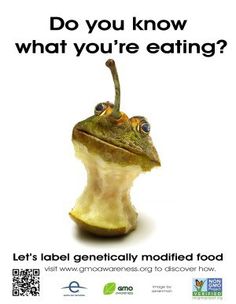
Have you ever looked at a picture and thought to yourself that who ever had posted the picture must have tried really hard to make you believe what you were seeing? In the genetically modified organisms world using photos is a huge form of advertising for both those who are pro GMOs and for those who are against GMOs. Using both the combination of imaging and words to invoke emotion from those who are viewing the advertisement plays a large role in how the public view genetically modified organisms. Personally if I were too see something like this on a poster in a grocery story I would wonder if what I was eating was safe. The sad part about this advertisements is it hard to find advertisements that are pro GMO. Naturally then it would make sense that the majority would rule against genetically modified organisms when all that they see is negative.

The pro-GMO adds are few and far between. Originally I was going to use a pro GMO advertisement but upon simply searching it, I found that the majority of the advertisements that came up were against GMOs. Upon looking at these articles I found that it was pretty clear what the writers wanted their readers to believe. There is not a lot of places that invites consumers to educated themselves, learn about GMO's and then make a decision. There is always two sides too a story, so if the pictures that you see about GMO's make you uneasy, then take sometime to be educated and see both sides of the story. We live in such a world that we have access too so much information. Take the challenge and find out for yourself.

Sunday, May 20, 2018

GMO...Are you confident in your knowledge?


Image result for GMO crop picturesWhat comes too your mind when you hear the term GMO? Do you feel like you have a solid understand or are there somethings that make you nervous? I know for me, I don't get uptight about GMOs but I do have my own set of questions. What has caused such an uproar about GMO's? Is there a reason to be nervous about GM crops? One that I would like to focus on for the next few blog posts is how the public view of GMO's effects a farmers ability to produce their crops. I would like to focus specifically on the crop of corn and wheat since both of them are the base of a lot of our foods now but before we go too far I would like to look at where GMO crops came from. 
GMO's began over 10,000 years ago when prehistoric farmers used natural selection to produce the most productive crops in order to increase yield and production. It wasn't until the middle of the 1900's that scientist looked closer at DNA strands and found the double helix. It wasn't until 1977 that scientist found that they could change these DNA strands. A DNA molecule called plasmid began to enter the nucleus and produce a tumor. Scientist developed a DNA molecule by splicing a double helix that was resistant to plasmid and the world of genetically modified organism began with the intent to produce food that would be more productive and insect resistant. (GMOHistory)
While this is a quick historic over view of Genetically Modified Organisms from my research there was one thing that I wanted my readers too keep in mind while we look at Genetically Modified Organisms. The farmers and engineers that produce genetically modified organisms eat the same food that the general public eats. They wouldn't put something that would be harmful in their own bodies so we can trust they wouldn't put something in the market that would be harmful too us. There is a lot of research and work that goes into produce genetically modified organisms. They are simply trying to find a way to feed an ever growing world on less of our valuable resources like land and water. (GMOsUnderstood)


Saturday, December 12, 2015

Good Old Fashion Donuts

I absolutely love this time of year! Especially with all of the goodies that are made and given around. I know in my family we are huge fans of homemade donuts! My mom has a killer recipe of real spudnuts that she got from my great grandma. It is a family tradition to spend some weekends with friends frying up donuts with a hot griddle of oil and nicely risen donuts!

During my freshman year of high school I took an elective health class. One big part of the class was learning how to read labels and know the nutrients content of the food we ate. I decided that I was interested in the calorie count and the nutrients contained in my moms donuts. Taking all of the ingredients we measured it all out and counted...lets just say I will probably never do that again for something that I love so much! I have been on the look out for a healthy alternative since then. Thats when I came across this recipe that makes donuts using sour cream.(See Complete Receipe

This recipe contain a much higher nutrient count than normal donuts for a fraction of the time to prepare them. It was a great find! They make a great breakfast food and is an excellent source of carbohydrates. They keep you full longer and are quick and easy. Give it a try! 
 

Tuesday, December 8, 2015

What's in Your Food?

The media has covered material about Genetically Modified Organisms and consumers have question about the safety of this technology. Clark Isrealson, Cache County Extension Agent, provides insight.

Saturday, November 21, 2015

The Revolution of Food- My Plate

In 1994 the USDA center for nutritional Policy and Promotion was established in the United States. Its purpose was to "improve the nutrition and wellbeing of Americans." It strove to provide reliable resources and information for Americans in order to improve their ability to select and consume healthier foods. They provided resources such as the food guide pyramid then the mypyramid that had some additional information about specific portion sizes and added in an emphasis in physical activity(Choosemyplate). In most recent years the My Plate food guide showed proportion sizes simply and clearly emphasizing the most important part of a diet, half of your portions being fruits and vegetables and the other being mostly grains with protein (MyPlate).

An interesting aspect of the revolution of dietary guidelines is how much they have changed over the years. During the early 1900s there was a huge focus on getting carbohydrates and protein. In the mid 1900s (the difference), the dietary guidelines changed again to having more fruits and vegetables, then additional changes were made to consuming less grains.

Nutrition guidelines are always changing to promote the healthiest way of living. Following updates and being on top of the current information is important for consumers. Choose My Plate.org is a great resources for information and additional understanding for individuals and families.

Tuesday, November 17, 2015

The Revolution of Food- GMOs

I have missed a few weeks since I last posted. Over that time the topic of food has been going through my mind so I studied it out and will produce a series over the next week about food, especially since it is getting close to the holiday season when a lot of people become concerned with their food consumption and seem to be very interested in exactly what kind of food they are eating, whether or not it is nutritious, and the how it is produced. GMO's or Genetically Modified Organisms is an example of a hot topic in the food industry right now. That can be a pretty scary term. What does that really mean to have a genetically modified organism? Is that consumable? Is it healthy at all? I had the opportunity to interview a family friend Clark Israelson, an Extension Agent for Cache County in Utah about GMO's and his take. (Later on I will have a pod cast covering the topic with more detail.) First let us define GMOs. A GMO is a Genetically Modified Organism that main purpose is to increase production and value of the product.(GMO facts) While talking to Mr. Israelson he stated that GMOs have been around forever, as animals have adapted and changed. It is the survival of the fittest at its finest as the weak genetics are eliminated. GMOs are used to increase crop production and produce a weed resistant, higher yield, more nutritious product. (GMO Benefits) Although I recognize that there is a bias, but with adequate research consumers can come to their own conclusion and choose for themselves. There are many resources for information, for and against the consumption of GMOs. A few would include, Food And Agriculture Organization of United Nations,International Union of Nutritional Sciences, and Genetic Literacy Project. These sources have facts from studies taken and information that is reliable.

Saturday, October 24, 2015

Are there Pumpkins?

There isn’t a better time of year to have pumpkin pie then during the holiday season. Although the pumpkins companies are experiencing some stress this year as the their crops are coming in and there is a huge shortage of pumpkins. In an interview with NPR News,  Roz O’Hearn from Libby’s Canned Pumpkin Company  said that there is generally enough pumpkins to give them a “cushion for next year,” but that there isn’t a cushion this year. There should be enough pumpkins to last until Thanksgiving but after that no one knows.(See Article)


No one wants to go this season with out pumpkin pie, so with this shortage of canned pumpkins consumers have to get a little creative! The best way to do that is to make your own. This isn’t hard too do. After scraping the pumpkin clean of the insides cut it in half. Preheat oven to 325 degrees and place each half of the pumpkin in the oven and cover with tin foil. Bake for about an hour or until tender. Scrape the pumpkin meat from each side and puree in a blender. (Pumpkin Puree Recipe)The puree can be kept in the freezer and used all year round. Enjoy your pumpkin!  

Monday, October 19, 2015

There's a Market

In early blog posts I talked a little about the need for support of small family farms and the number of individuals going into agriculture careers, particularly those with an agriculture back. Something that has been brought to my attention is the number or individuals entering an agriculture based occupation with little or no agriculture back ground. While the number of farmers has decreased, the number of individuals who are new to agriculture occupations has increased. (start to farm)

These individuals have a drive to succeed and produce quality products for consumers. As a result of this increase of agriculturist there are additional resources for these new farmers. The United States Department of Agriculture provides multiple introductions and educational information for new farmers including the New Farmers Guide and Start to farm financial support.

Now I understand that not everyone wants to be a farmer but there is so much that each person can do to help support agriculture and specifically these new farmers. In an early blog post I discussed the purpose of small family farms and how the producers at these farms bring their products to farmers markets. I am going to put in another plug for these farmer markets. A lot of the farm represented at the farmers markets are owned and operated by first time agriculturalist. So many are just starting out and producing quality products.

There are farmers markets every where. Edible Wasatch and similar websites can direct you to the farmers market nearest to you. Find a market and support a farmer today!

Monday, October 12, 2015

It Runs In the Family


Have you ever taken a drive out through the country side and enjoyed a quiet afternoon away from the city noise? As you drove did you notice the acres of farm land? Have you ever stopped to think about who runs that land? The majority of these small farms are run by families who have passed the lifestyle of farming down from generation to generation. Although, according to The Real Truth Magazine only one-third of these family farms have a successor, someone who will continue the farming tradition. There has been an ever increasing number of large scale farms. As large commercial farming increases, the number of small family farms decrease as generations move farther and farther from agriculture back ground. The need for more land to build houses and provide space for an ever increasing population has been the cause of many of these small family farms selling out.

What is going to help keep these family farms from becoming completely extinct? Many of these family farms provide organic produce that can be found at local farmers markets. While these products may not have as long of a shelf life they provide a healthy alternative that can be frozen, bottled, or canned for later use. During this time of year there are family owned pumpkins patches and produce stands that can be a great family opportunity. (USDA- Small Family Farms)There are so many ways that small family farms can be supported but it needs to start now. 

Monday, October 5, 2015

The Age of the Farmer


As a child, I remember my dad after a long day of work, picking up his guitar almost every night to play a song or two before we would all go to bed. One of the songs he would sing was an old Waylon Jennings song, "Mama's don't let your babies grow up to be cowboys, don't let them pick guitars and drive them old trucks, make em be doctors and lawyers and such."  I would laugh at that song and think to myself, why would anyone not want to be a cowboy or a farmer? Isn’t that every kid's dream?

In the last 5 years, research has found the age of the farmer is increasing from 55 to 57, with 30% of farmers over the age of 75. Twenty percent of U.S. farms today are operated by those with 10 years or less of experience.(Young people on Farms)

So what would keep someone from staying on a farm and continuing to work in agriculture?  Jennifer Leavy and Naomi Hossain of the Institute of Development Study found that there are four reasons someone would move away from agriculture:


  •      Youth want better education to get better jobs
  •  Farming is mentally and physically challenging  
  •   They don’t consider it as a future because of the lack of access to inputs and land   
  • Changing norms, new opportunities to seek education and employment 


The generation gap between the farmers of yesterday and farmers today continues to grow, where less and less know about farming, leaving the older farmers with no one to take their place. So whether or not you are involved in agriculture consider what you can do to increase agriculture awareness and job opportunities. As the age of the farmer goes up and the world population continues to rise, the need for agriculture based workers needs to be rising with it. Jobs are waiting to be filled.